Vintage Cars in Rhodesia
By the 1970s Rhodesian roads were of a very high standard – among the best in Africa. A network of 22ft mat double lane highways (known as wide tar) joined all the main centres with older 9ft mat single carriageways (known as narrow tar) and strip roads (known as strips) between the smaller centres. Strip roads were introduced in the early 1930s as a cost effective upgrade from gravel or dirt surfaces which were then universal in Africa and, in many parts of Africa, still are. Strips provided all weather motoring even during the rainy season and by the time of WWII Rhodesia had the finest roads in Africa at a time when even South Africa had to make do with gravel roads. Both strips and narrow tar roads were perfectly adequate for the low volume of traffic and when meeting an on-coming car each gave up one strip and ran with the nearside wheels on the gravel and the offside wheels on the left hand strip. A similar procedure applied in the case of narrow tar. By the 1970s those between the main towns and cities which experienced higher traffic volumes had been upgraded to full width tar. See here for further info on Rhodesian roads and road travel.
The good roads, low volume of traffic and an ideal climate all lent themselves to a perfect country for motoring – both vintage and modern. The second Rhodesian National Vintage Rally was held in 1970. The first section below, is a report by participating STD member (T351) Peter Theobald which first appeared in the STD Journal in 1970. Following that is a local Rhodesian report written by Quentin Lloyd.
.
RALLYING IN RHODESIA
by Peter Theobald.
I purchased my Talbot ’90’ from Brian Fidler at Oxford last August (’69) and after almost a year of restoration work (still incomplete) I entered it for its first run in the 2nd Rhodesian National Vintage Rally (also the 15th South African Vintage Rally). We motored in company with my Talbot V.D.P. ‘105’, crewed by friends, from Johannesburg to Bulawayo via Beitbridge, a distance of around 530 miles on the Friday and Saturday along very good tarmacadam roads in bright sunshine and temperatures around 70 – 80°F. Sometimes we never saw another car for up to a quarter of an hour. We cruised at around 50 – 55 and the ’90’ achieved 26 m.p.g. on 93 Octane – a trouble-free and enjoyable run.
.
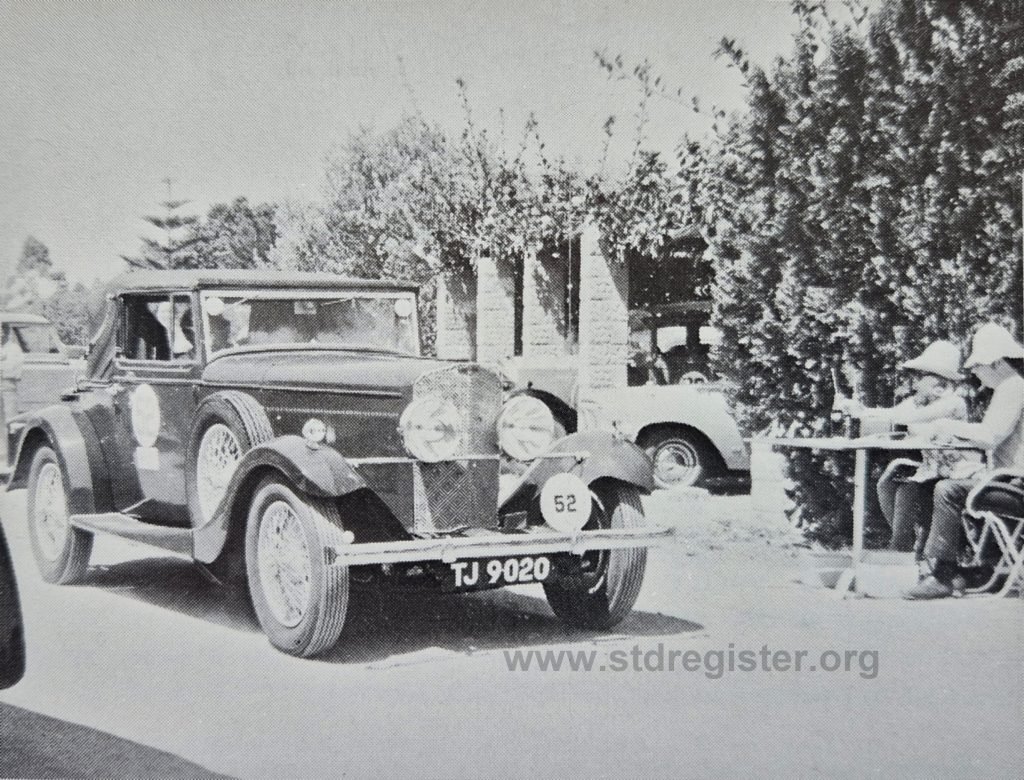
Peter Theobald’s Talbot 90 at a Rhodesian rally checkpoint
.
The Rally started from Bulawayo around midday on Monday with a 100 mile regularity-run to Gwelo on sealed instruments through twelve secret and hidden controls. No lateness was permitted, but you could run up to 10 seconds early without penalties, which were a point per second. We finished the day 8th out of 78 starters with a total error of 61 points. The leader, a ’28 Rolls ’20’ from Pretoria only had 30 points error, which will give you some idea of the competition. On Tuesday and Wednesday we covered the 136 miles from Gwelo to Fort Victoria and the 160 miles from Fort Victoria to Umtali respectively, most of which was regularity, but with open instruments. Some of these roads were the famous Rhodesian tarred strips which just take the track of a vehicle, and tarred mat, the eight foot wide surface that one has to move half off when meeting an oncoming vehicle. This is not so good for paintwork or windscreens as stones tend to fly if the approaching vehicle is doing more than about 30 m.p.h.
On reaching Umtali on the Wednesday afternoon we moved into our hotel for a free day on the Thursday. The organisers laid on a 70 mile motor coach trip to lnyanga in the Eastern Highlands where some of the views are breath-taking – wonderful country!
On Friday we were back on the road heading for Salisbury. The first section of 58 miles was open and run as a fuel consumption test based on a ten miles per gallon formula. The rest of the day’s run was in three sections making a total of 162 miles and we arrived in Salisbury around 4.30 p.m. to be photographed and interviewed by Rhodesian TV. We put up best performance on this run, our score sheet showing eight zeros, one ten seconds and another zero, making a total error of ten seconds over ten controls, and all those at one control!
Altogether a very good Rally, in spite of a couple of minor route schedule errors which caused most competitors to do some frantic re-calculations. However, this merely proved that they were right and the route schedule was wrong.
Of the cars themselves, there was a pretty good cross section from a 1915 model T Runabout from Pretoria to a 1938 Bugatti 57C Coupe from Johannesburg. Fords seemed to dominate with 17 entries, at the other end of the scale eight Rolls Royces turned out from a ’22 Ghost to a P 111 Sedanca De Ville by Park Ward. The only two Talbots ran like clockwork in temperatures sometimes up in the 90s, the ‘105’ finishing 11th overall and myself in the ’90’ 13th.
We set out on the 717 mile return journey to Johannesburg on the Monday, the ‘105’ and ’90’ in close company. On the approach run to Fort Victoria (of Zimbabwe Ruins fame) we actually put in 62 miles in 60 minutes. Unfortunately this was not to last as the ’90’ went on to five cylinders about 40 miles north of the border at Beitbridge. Having discerned no compression but no undue noises coming from the offending cylinder (No. 6), I assumed a burnt valve and pressed on after the overnight stop in a motel at the Bridge. Downhill was fine at 60 plus, not too bad on the level at 50, but, oh dear what a bind uphill! The ‘ 105′ found this a bit tiresome, but our friends stuck with us all the way home.
On removing the cylinder head a few days later, I was astonished to find that about a fifth of the exhaust valve head missing altogether, like a section cut out of a cake; apart from this no other damage. One thing I learnt about the ’90’ is that it is a good performer in spite of its 2920 lbs. weight and that I should have entered it in a higher speed group. Keeping it down to 35 mph, which was the maximum speed for our group, wasn’t easy.
UK rally types may be interested to know that a lot of route check mileages were given to a hundredth of a mile, speed changes were frequent, up to eight or ten in a section and they even gave us speeds including half miles an hour. Which all meant that crews had to work quite hard to finish anywhere; I know my wife Daphne and I had to.
Next year the 16th South African National will be organised by the Pretoria Old Motor Club for the first time, and I gather they are thinking of incorporating a portion of Swaziland in the route schedule. What about having an official STD entry?!

1970 Rhodesia map showing main roads and the rally route – click on map to zoom in
.

50+ years later and still going strong – 1931 Talbot AM90 as rallied in Rhodesia by Peter Theobald
.
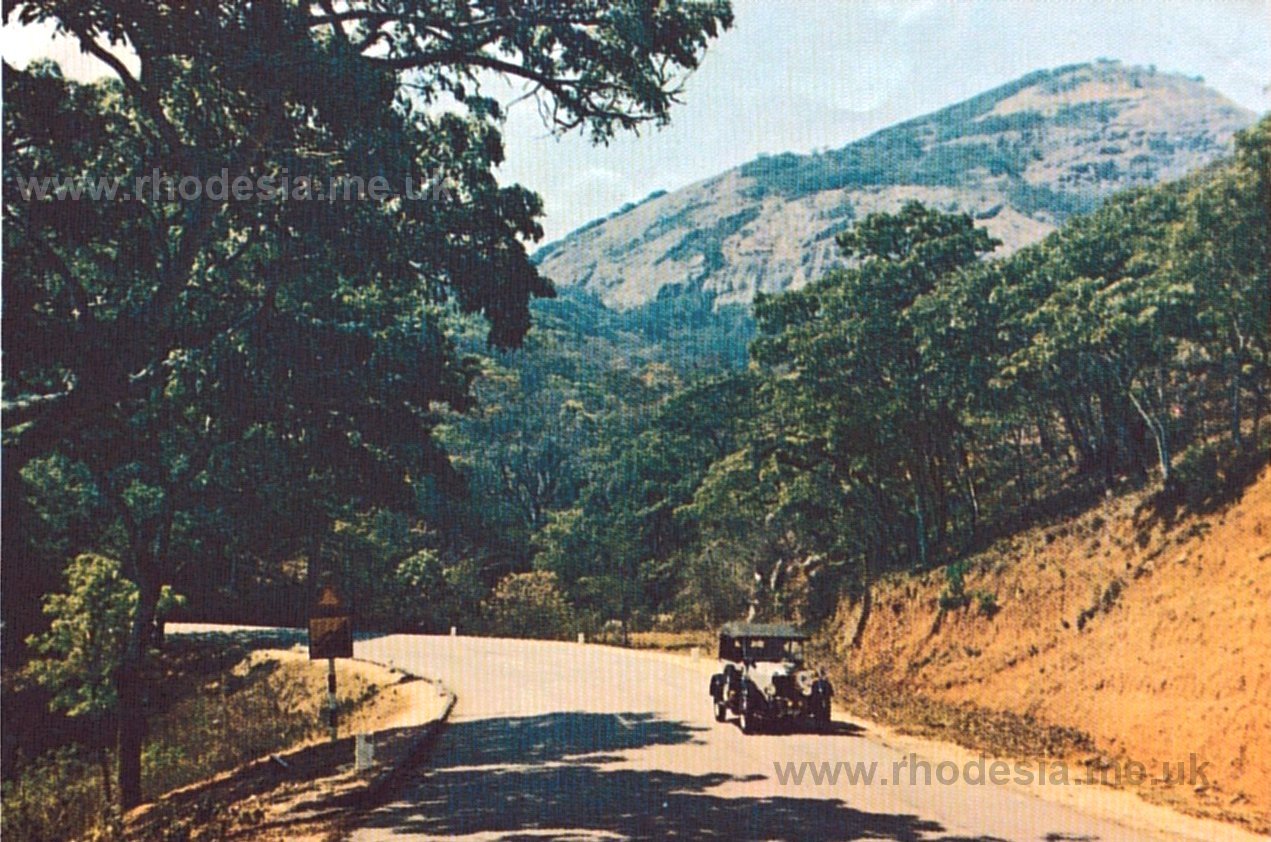
A bullnose Morris making its way up a steep hill in Rhodesia’s eastern highlands
.
Vintage Car Rally in Rhodesia
by Quentin Lloyd
A jaunty, bright yellow Austin Seven bouncing along the road followed by a sedate and immaculate Rolls Royce, its chrome work twinkling in the sun, was just one of the many light moments during the Mobil Second Rhodesian National Vintage Rally which, in five days, took a record 75 entrants through some of Rhodesia’s most beautiful countryside.
Behind the lighter aspects lay more than two years of planning for the event, which was also the fifteenth South African National Veteran and Vintage Car rally, and a lot of hard work to smooth the path for the competitors. The result: one of the most successful events in the series, and the firm conviction by all who travelled from outside Rhodesia to compete, that “Rhodesian hospitality” is indeed a byword.
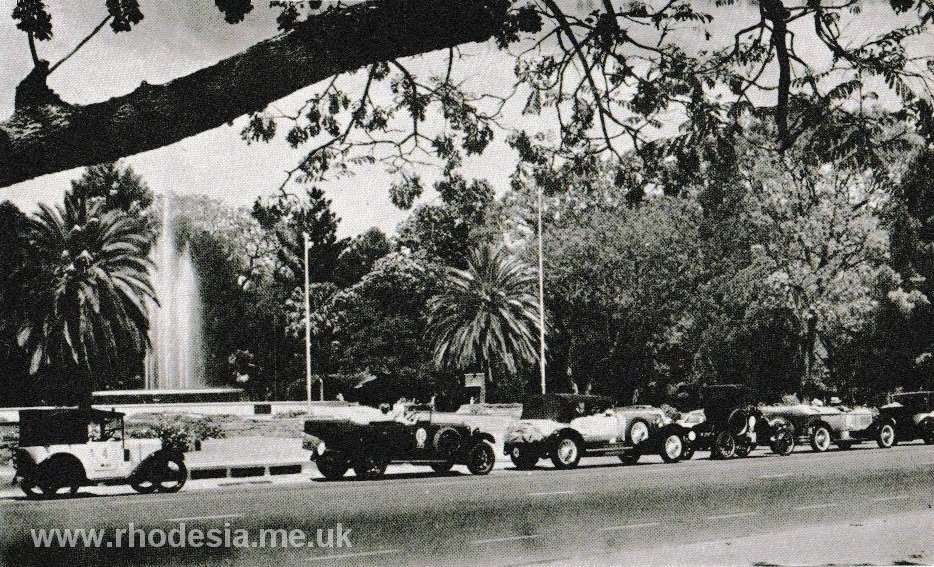
Some of the competitors taking a break in Centenary Park, Bulawayo before setting off
.
“I would not have missed it for the world,” said Carl Kilner, who drove a 1929 Graham-Paige down from Malawi to compete. He was one of eight entrants from that country.
These words, from a competitor who had his fair share of trouble in the early stages with an overheated engine, were echoed by many others taking part, including Erwin Kuschke from Pretoria who is a veteran of the vintage series.
He drove the oldest car in the event, a 1915 Model T Ford, and his verdict: “A very good run, but can we please have cooler weather next time?” Temperatures rose to 38°C on the most strenuous section of the 1 000 kilometre route along the lowveld.
Several cars were victims of overheating, but there was a light side to this too. One competitor, whose fuel pump could not cope with the high temperatures, managed to keep going by opening a cool drink and pouring a little of the cold fluid on the fuel pipes.
A Rolls Royce owner with a split inner tube was able to continue by fitting a tractor tube – a spirit of ingenuity that marked the entire event.
Special trips were laid on along the route to some of Rhodesia’s better-known tourist attractions. At Fort Victoria flights were provided over the Zimbabwe Ruins , at Umtali special tours were available to the Vumba Mountains and Inyanga, and from Salisbury planes were chartered for a flight over the magnificent Victoria Falls.
For many this was an all-too-brief visit, as was summed up in the words of a Ford A Phaeton owner from South Africa who said: “I am certainly coming up here for my annual holiday next year.”
All along the route, from the moment the cars arrived at Bulawayo for the start, crowds turned out to cheer and welcome the competitors and civic receptions were given at every town and city where overnight stops were made.
For many of the competitors this was a return visit, following the 1965 event which was also staged in Rhodesia.
.
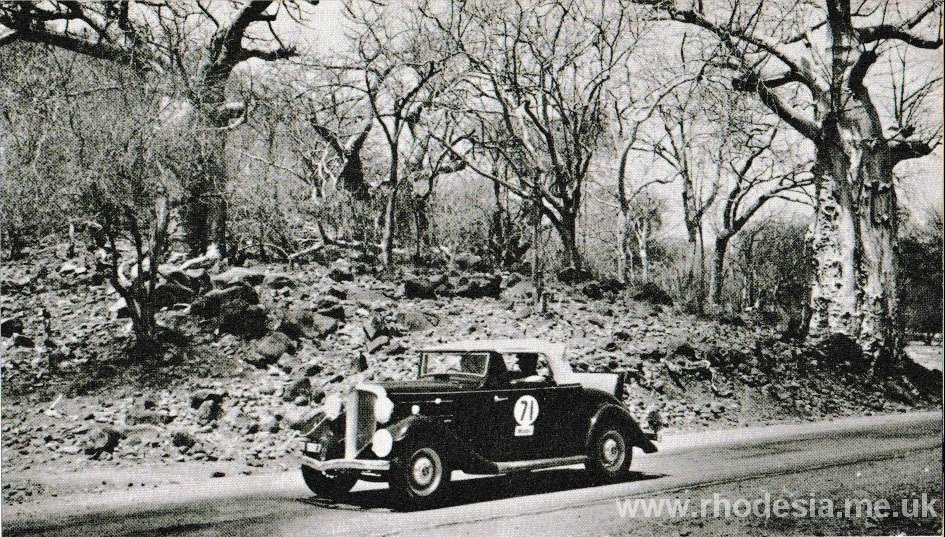

The picture of the Railton car, shown above, crossing the Birchenough Bridge over the Sabi River in Rhodesia’s lowveld does not fully convey the grandeur of the setting. So here, below, is a better view taken in the dry season and showing also the foothills of the eastern highlands in the distance. – CW
.
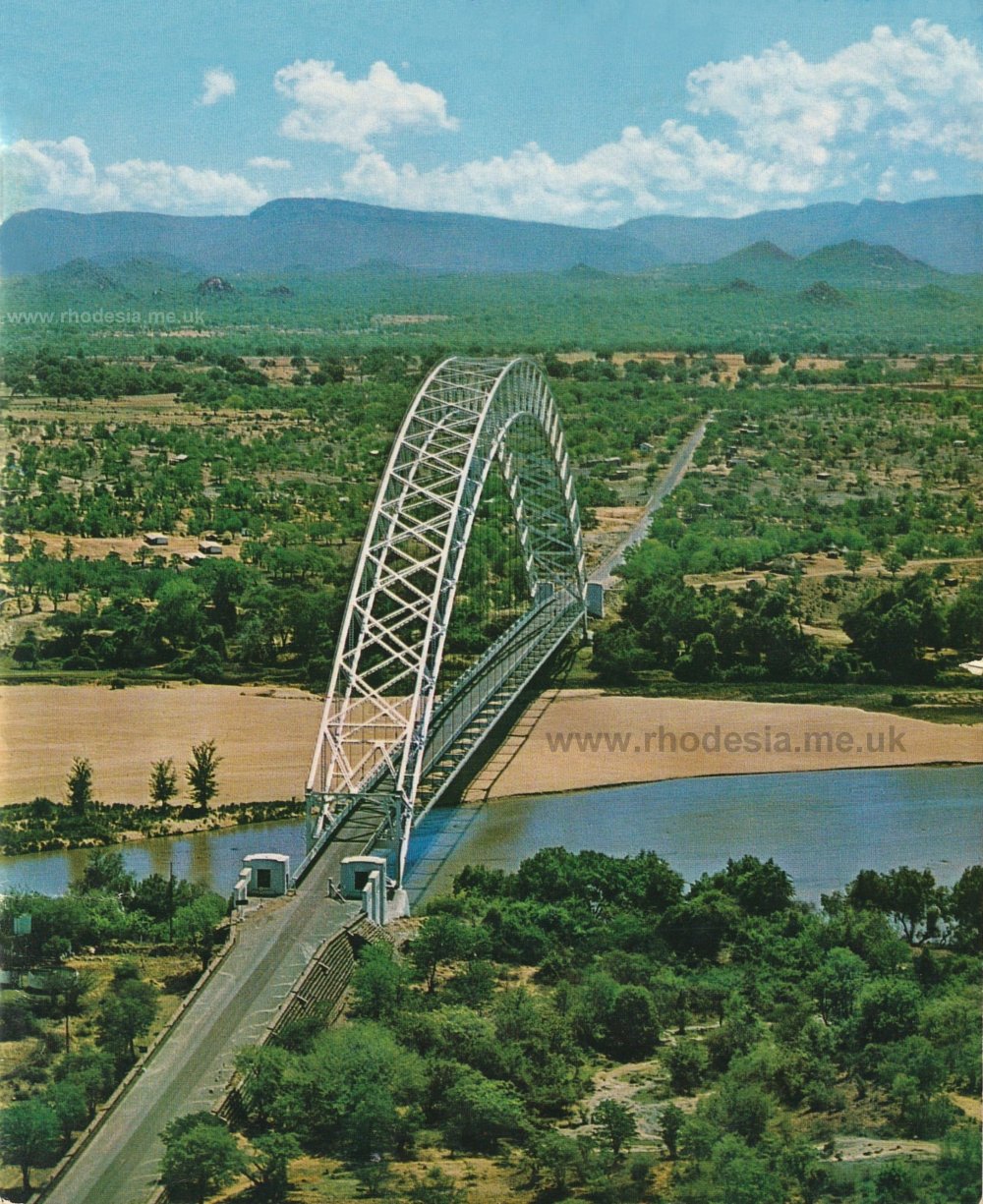
Birchenough Bridge from the air looking east and seen here in the dry season. (click image to zoom in)
The Bridge was completed in 1935 and was designed by Ralf Freeman who was also responsible for the similar bridge across Sydney harbour.
.
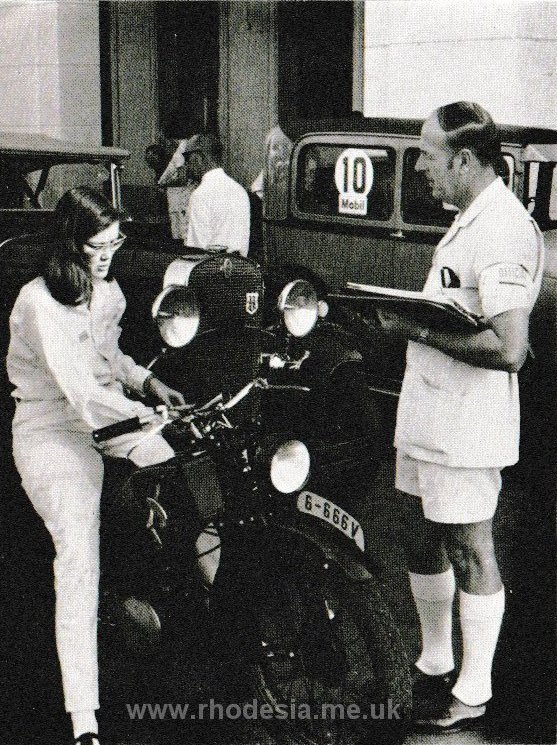
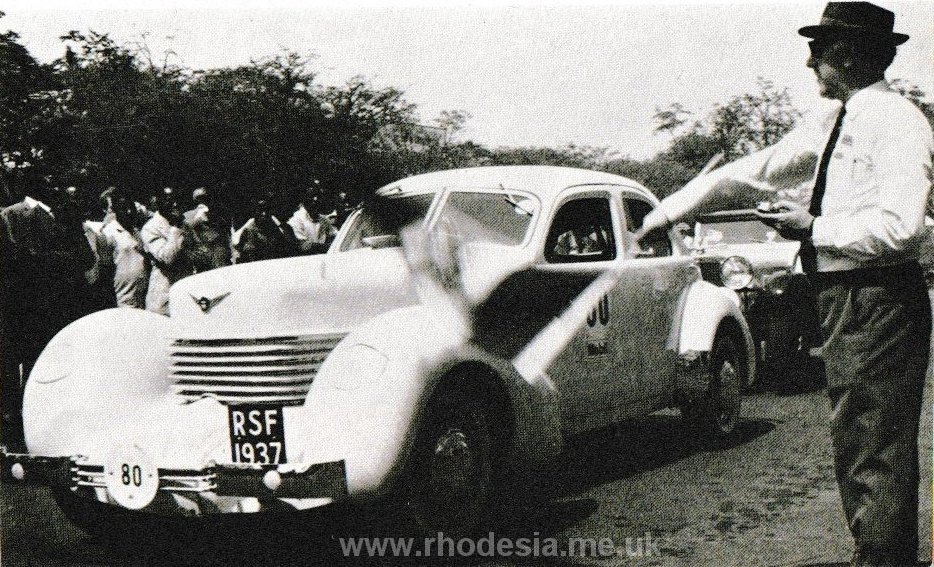
.
In a special message the Minister of Information, Immigration and Tourism, Mr. P.K. van der Byl, said: “Within the limitations imposed both by time and the need to accommodate large numbers in one centre, the organizers have tried to make the route as interesting and as varied as possible, and although you will not be visiting all of Rhodesia’s scenic spots, it is unlikely that any route could have been planned that would have allowed you so see more than you will during the course of this event.
“In the days when your vehicles were manufactured most of Rhodesia’s roads were dirt, full of ruts and corrugations and with low level bridges at the mercy of every rainstorm; the celebrated strips only made their appearance at the end of the Vintage era. The roads you will be travelling on during the rally will be of tarmac surface, except in a few areas where road improvements are still being carried out.”
These were prophetic words, for the Mayor of Umtali took the opportunity of the rally to open a new, dual carriageway road, from Umtali over Christmas Pass on the Salisbury road.
As the vintage cars would their way over the new pass road, waved on by the Mayor, a Model A Ford was used to make a final ascent of the old pass road and thus officially close it.
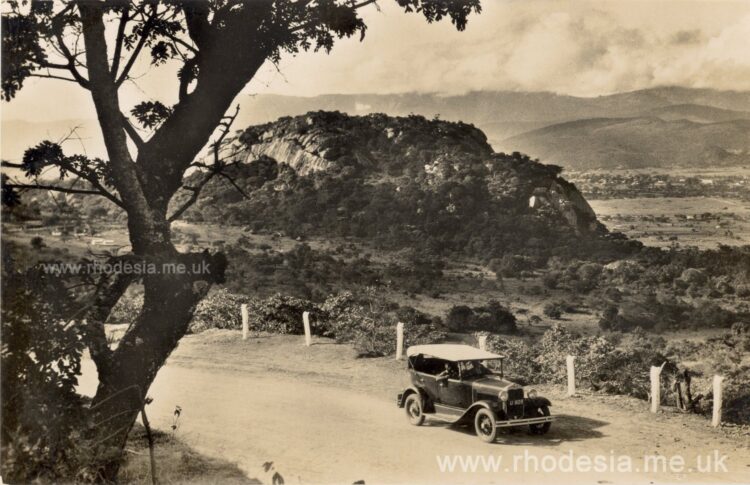
Christmas Pass, Umtali, 1936
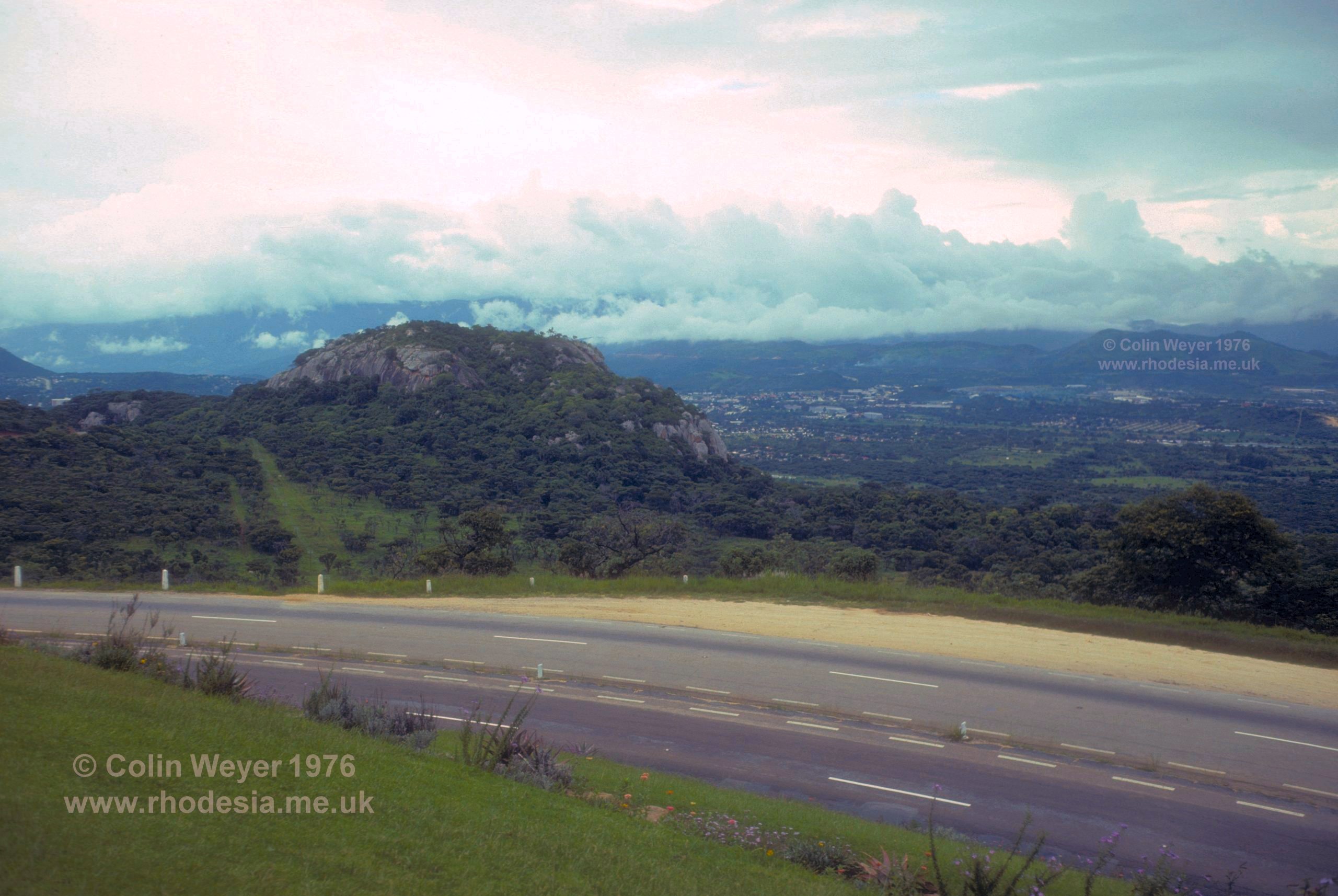
My photo at the same spot: Christmas Pass 40 years later.
The mayor of Umtali opened the new dual carriageway in 1970 and the vintage rally cars were the first to use it.
For the Rhodesian contingent Salisbury was very nearly the end of the ride, but for the visitors many kilometres of motoring lay ahead after the finish. Some of the cars covered as much as 6 500 km from leaving home to their return – a high tribute to the cars and to the months and even years of work lavished on them by their owners. Of the 75 vehicles that started, 72 arrived at the finish line – a remarkable performance – and, the day after the rally, the cars were on parade in central Salisbury showing no signs of their arduous journey, immaculate as they lined up for the judging of the concours d’elegance.
.
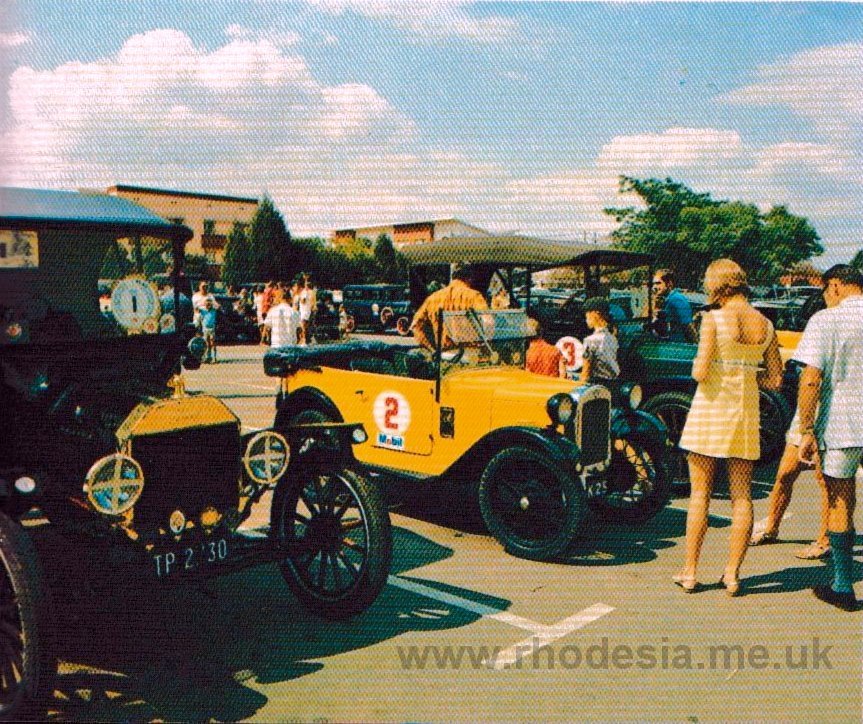
The 1915 Ford Model T on the left was the oldest car in the rally
.
The spirit of those taking part – such as Tony Ely from Malawi who had to paddle with his legs to get his diminutive 125 cc motorcycle over the steeper hills – careful planning and Rhodesia’s built-in readiness to roll out the red carpet for any visitor combined to make this one of the most memorable of vintage rallies in southern Africa.
.
.
Those who wish to read more about motoring and travel in Rhodesia may care to visit these Window on Rhodesia pages:
In The Beginning – An account of a pioneer journey to Rhodesia in the early 1890s
How to start a new country – Pioneer Travel in early Rhodesia